Ebook Download Innovation Methods Mapping: De-mystifying 80+ Years of Innovation Process Design, by GK VanPatter, Elizabeth Pastor
The factor of why you can obtain and also get this Innovation Methods Mapping: De-mystifying 80+ Years Of Innovation Process Design, By GK VanPatter, Elizabeth Pastor quicker is that this is the book in soft file form. You can check out guides Innovation Methods Mapping: De-mystifying 80+ Years Of Innovation Process Design, By GK VanPatter, Elizabeth Pastor anywhere you want also you remain in the bus, office, house, and other locations. Yet, you might not have to relocate or bring the book Innovation Methods Mapping: De-mystifying 80+ Years Of Innovation Process Design, By GK VanPatter, Elizabeth Pastor print wherever you go. So, you will not have much heavier bag to bring. This is why your selection making far better principle of reading Innovation Methods Mapping: De-mystifying 80+ Years Of Innovation Process Design, By GK VanPatter, Elizabeth Pastor is truly practical from this situation.
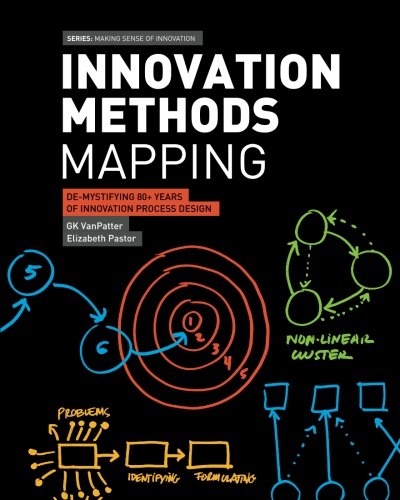
Innovation Methods Mapping: De-mystifying 80+ Years of Innovation Process Design, by GK VanPatter, Elizabeth Pastor

Ebook Download Innovation Methods Mapping: De-mystifying 80+ Years of Innovation Process Design, by GK VanPatter, Elizabeth Pastor
Just how an idea can be got? By looking at the stars? By going to the sea and considering the sea weaves? Or by checking out a publication Innovation Methods Mapping: De-mystifying 80+ Years Of Innovation Process Design, By GK VanPatter, Elizabeth Pastor Everyone will have particular particular to gain the motivation. For you that are passing away of publications and always obtain the inspirations from books, it is actually wonderful to be right here. We will show you hundreds compilations of the book Innovation Methods Mapping: De-mystifying 80+ Years Of Innovation Process Design, By GK VanPatter, Elizabeth Pastor to read. If you similar to this Innovation Methods Mapping: De-mystifying 80+ Years Of Innovation Process Design, By GK VanPatter, Elizabeth Pastor, you can additionally take it as all yours.
Checking out, again, will certainly give you something new. Something that you do not know then disclosed to be renowneded with the e-book Innovation Methods Mapping: De-mystifying 80+ Years Of Innovation Process Design, By GK VanPatter, Elizabeth Pastor message. Some understanding or driving lesson that re got from reading books is vast. A lot more books Innovation Methods Mapping: De-mystifying 80+ Years Of Innovation Process Design, By GK VanPatter, Elizabeth Pastor you check out, even more understanding you get, as well as much more possibilities to consistently love reading books. Due to this factor, reading publication should be begun with earlier. It is as just what you can get from the e-book Innovation Methods Mapping: De-mystifying 80+ Years Of Innovation Process Design, By GK VanPatter, Elizabeth Pastor
Obtain the perks of checking out behavior for your life design. Schedule Innovation Methods Mapping: De-mystifying 80+ Years Of Innovation Process Design, By GK VanPatter, Elizabeth Pastor notification will consistently connect to the life. The genuine life, expertise, scientific research, health and wellness, religion, enjoyment, and also a lot more could be discovered in created publications. Numerous writers supply their encounter, scientific research, study, and all things to show you. One of them is via this Innovation Methods Mapping: De-mystifying 80+ Years Of Innovation Process Design, By GK VanPatter, Elizabeth Pastor This e-book Innovation Methods Mapping: De-mystifying 80+ Years Of Innovation Process Design, By GK VanPatter, Elizabeth Pastor will certainly offer the required of message and also declaration of the life. Life will be completed if you know more points via reading publications.
From the explanation over, it is clear that you should read this e-book Innovation Methods Mapping: De-mystifying 80+ Years Of Innovation Process Design, By GK VanPatter, Elizabeth Pastor We offer the online book qualified Innovation Methods Mapping: De-mystifying 80+ Years Of Innovation Process Design, By GK VanPatter, Elizabeth Pastor right here by clicking the web link download. From discussed e-book by on the internet, you can provide much more perks for many individuals. Besides, the readers will certainly be also quickly to obtain the favourite e-book Innovation Methods Mapping: De-mystifying 80+ Years Of Innovation Process Design, By GK VanPatter, Elizabeth Pastor to read. Locate the most favourite as well as needed book Innovation Methods Mapping: De-mystifying 80+ Years Of Innovation Process Design, By GK VanPatter, Elizabeth Pastor to read now and here.
Making sense of innovation process design is the subject of this new Humantific book. With an avalanche of innovation methods now in circulation within the marketplace, sorting out and making sense of the mess can be a daunting task. Spanning an 80+ year time period and numerous communities of practice this book offers a new and reusable analysis framework to do just that. The Methods Mapping framework focuses on 10 lenses or views that have been determined to be important in understanding innovation process today across multiple knowledge arenas. Key to the analysis is that the framework unpacks each process from its original graphic depiction in order to better understand the activities within. The framework introduces advanced considerations such as Starting Points, Think Balance, Behaviors, Method Mode, Roles, and Values. These considerations are designed to significantly enhance the way innovation processes are considered today and tomorrow. This 212 page volume with its Forward written by Richard Saul Wurman is intended for advanced practitioner leaders, organizational leaders and social change leaders. UPDATE PLEASE NOTE: This book is for advanced practitioners. It is not an introduction to the subject of innovation methods. It is ideally suited to readers who have active interest in process design, process history and process analysis. For sample reviews from industry experts see Advance Praise in the preview. See preview here: https://issuu.com/humantific/docs/innovation_methods_mapping_book_pre
- Sales Rank: #369959 in Books
- Published on: 2016-12-20
- Original language: English
- Dimensions: 10.00" h x .54" w x 8.00" l,
- Binding: Paperback
- 230 pages
Most helpful customer reviews
3 of 3 people found the following review helpful.
High on production value, light on content
By Amazon Customer
I expected this to be something it wasn't. It's a highly produced and polished book, but the content lacked the depth and tactical use that I was hoping to find after reading about the book. Because of the price of the book and its lack of usefulness to me, I returned it.
I'd be hard pressed to explain who I think this book was written for. However to be fair, I might be far outside of the target audience, ymmv.
7 of 7 people found the following review helpful.
Could be a good start on something bigger
By D. W. Francis
Garry VanPatter and Elizabeth Pastor have been researching and writing about design methods and practice at least since the late 90's when he was the Vice President and a Co-Founder of the Innovation Acceleration Labs at Scient. In this book, they have collected 63 design processes, representing a wide range of approaches, including many of the big institutional and educational names in Design Science and Design Methods, including L. Bruce Archer, Buckminster Fuller, FROG, and IDEO as well as some that you probably haven't heard of.
Each process is presented as two facing pages, the first of which presents VanPatter and Pastor's interpretation of it. The second page graphically presents an analysis, organized as a Step-by-Step view (Process Flow), Hemisphere View (Pattern Optimization or Creation), Quadrant View (consisting of four choices; Execute & Measure, Discover and Orient, Optimize and Plan and Define and Conceptualize), a Starting Point (Upstream or Downstream from a brief) , Method Type (Zone or Step), Mode (Mixed or Split) and Use (Individual or Group), whether the roles of the designer are explained by the method and if there are any Values asociated with the method (Yes or No).
The Process View illustrations and Analysis graphics do a good job of organizing and presenting what would otherwise be a complex, multi-variable analysis of a still evolving, very complex and at times surprisingly contentious topic and if you are looking for a way to do side by side comparisons using VanPatter and Pastor's metrics this would be a good book for you - with some caveat's;
Discovering and recording an objective history of "design methods" and "designing" remains a difficult undertaking because of it's association with the relatively modern practice of industrial scale design and manufacturing, which is still new enough to not be standardized.
Existing at the intersection of art, science and business calls for a balanced discussion of the relative merits of thinking, feeling and doing within the practice of design. This is where Innovation Methods Mapping stumbles. All 63 processes appear to have been interpreted and analyzed thru the lens of the Humantific method, which is at least partially the product of the authors. The work of L. Bruce Archer (Royal College of Art) and David Kelley (IDEO/d.school) suffer the most deeply from this perceptual bias.
In addition, some of the most influential and well known names (Bauhaus, Harold van Doren, WED/Imagineering, NASA Systems Engineering, Robert McKim, James Adams and John E. Arnold - at least two of which which have significantly influenced the modern Design Methods movement) are absent. There are further puzzling irregularities; Archer, Rittel, IDEO and LUMA are all in the same Design Process Model swim-lane, in spite of Archer being labeled Upstream and Rittel, IDEO, the d.school and LUMA being labeled Downstream - which claim is also contradicted, as the IDEO/d.school model is being applied regularly to organizational change. (see https://designthinking.ideo.com/?p=1282)
On a deeper level, some references are second source, or simply sparse. The Archer Process description only references Rowe and indicates that it had no associated "values". The section erroneously titled D.SCHOOL DESIGN THINKING PROCESS has only single reference to "d.school bootcamp bootleg" which was, according to the d.school website; "...originally intended for recent graduates of the Bootcamp: Adventures in Design Thinking class."
I also question the value of inventing over a dozen terms and acronyms which are apparently unique to the Humantific method to describe ideas which have been previously discussed in depth in existing literature. If the goal of the book is to expand, clarify and simply the reader's knowledge of creative problem solving approaches creating a new set of descriptive terms is counterproductive. The glossary also refers to "right brain" and left brain value systems, in spite of the fact that hemisphere dominance is rapidly being abandoned for a tri-layer model of brain function.
In at least one case (Squiggle) the Overview Analysis statement does not match the Original Process View. It states that the process begins with Research and ends with Evaluation when the figure begins with Research ends at Design. The text below is a list of tools associated with each of five phases, not two, three or four as stated in the Overview Analysis.
I don't wish to be overly hard on this book. It is nicely organized, well presented and attempts to address a real need both within education and industry. Unfortunately, there were enough issues with the descriptions and analysis of methods with which I am intimately familiar to raise red flags regarding its overall accuracy and objectivity. For that reason alone I would not consider it an authoritative and balanced reference work. It also fails to address the deepest issue of all; why the gaps between the artistic, scientific and business world views exist in the first place and if and how any of the cataloged methods might address that gap. Until then the tug of war between the arts, science and business will likely continue unabated.
2 of 2 people found the following review helpful.
This is not a how-to book, and it's still useful
By Alan
First, a disclosure that I know GK in a limited way through discussions on LinkedIn and one enjoyable lunch in London. Second, I've worked in the field of innovation and applied creativity for around 25 years. That doesn't mean I have all the answers - it means I have a fair amount of applied experience, and I value people like GK and Elizabeth who are willing to put in the research and effort that I'm not.
The first problem in the field is that concepts like innovation, creativity, design, problem solving, decision making (and others) overlap in some of their ideas, language and tools, which makes it ripe for confusion and argument. The second problem is that these topics attract smart people who like to innovate, improve, redesign etc, so a) it's hard to agree anything and b) the field is constantly moving. That's ok - it comes with the territory - but it also means it's hard to differentiate fundamental 'truths' (if there are such things) from the noise, fluff and argument.
So to the book.
First off, it is not a 'how to' book - it doesn't tell you how to innovate. It doesn't tell you how to choose between the methods it catalogues, and it doesn't tell you how to use any of the methods in the book. That's not a criticism, just a statement of fact. What it is is an attempt to create a language and map capable of handling a list of 63 methods covering the history of such methods over the last 80 years and providing a way to compare and discuss them. In that sense it's more of an 'academic' book, in that it will be of most interest to people teaching thinking about these kinds of methods, and people like myself who consider themselves lifetime students of the way people think about innovation and what they do as a result.
Some comments have complained that the authors have invented new language which in some way is 'theirs' and that's a criticism. Fair enough, except I would argue, we all use our own language loosely, and GK and Elizabeth didn't just throw this stuff together for copyright reasons. As someone who worked in big firm consulting for a long time, I know the difference between language for marketing purposes and a thoughtful attempt to reframe more familiar terms in an attempt to make us think harder about what we really need. As an example, for decades we have lived with 'divergent vs convergent thinking' and or 'generative vs focusing' as terms for the two styles of thinking that together form a basic creative unit. GK and Elizabeth have even listed all the terms used, and then created the terms Pattern Creating and Pattern Optimizing as alternatives. Not instantly understandable, but that's the point. It's not about the words, but what they mean, and actually Pattern Creating and Pattern Optimizing are much closer to what goes on inside and between people trying to innovate if you look at their definitions.
I haven't met Elizabeth, but the fact she and GK have worked together for so long makes me think they share some common ways of thinking (as in this book) and when talking to GK I always find myself having my beliefs and preconceptions stretched, being forced to confront how I see the world and it's implications. And he manages to do that without ever telling me what to think or to pretend he is right.
Which brings me to some other complaints about this book, that GK and Elizabeth have created a map and framework where their Humantific method is the only one that fits all the criteria i.e. that they created the method first, and then the map to justify it. OK, well, again, we all see the world through our own maps, so on one level they are being accused of something we all do - it's called being human :-) Second, I know of only one or two other people in the field that know it's history and materials in as much depth as GK. And I would say their method is a result of the mapping process i.e. the map came from a genuine attempt to understand the history of the field and, as someone else has commented, I've not seen anyone else do this so well. If you think the map has limitations, of course. Produce a better one and you'll see how hard this is.
And if you had spent years trying to create the map, why would you then create a method of your own which didn't attempt to learn from the process? This is a book to read in the same way it's been produced, thoughtfully and in discussion with a range of people with different views. I admired the overall structure, and I'll finish with that.
The book starts, without saying this explicitly, by looking at the field in different ways, to help you begin to make sense of it in new ways. That's one of Humantifics real strengths - Sensemaking not as most people understand it (does it make sense in my current maps) but as making new sense of something.
- it says this is for advanced (experience) practitioners
- it says its imperfect and not comprehensive
- they say their language could be seen as jargon and put the Glossary up front, not in the back
- it sets the scene with different ways to list the methods, it's 10 lenses up front and 25 key findings
All of the 10 lenses and 25 findings are not easily digested - they have depth beyond the quick read. They then 'map' each method against the 10 lenses. What I found most useful was not arguing with each categorisation (which will always be subjective) but wondering how I would map the same methods and looking for patterns and biases.
And then for me the real power of the book is at the back - two blank templates and guidelines to map your own process. This to me is the main message of the book. It's not about whether the listed methods are 'better' or 'worse' - in real life they all get flexed and changed anyway. The main question is, now you've been woken up to the history and range of methods, and all their capabilities and flaws, what are you going to do? How will you innovate, and how will your process deliver the results you need for the people and context you are working with?
That question over the years has started many arguments, with people defending their personal preferences. This map is imperfect, but it's a really interesting step along the road to a more useful way to compare perspectives and discuss methods.
See all 8 customer reviews...
Innovation Methods Mapping: De-mystifying 80+ Years of Innovation Process Design, by GK VanPatter, Elizabeth Pastor PDF
Innovation Methods Mapping: De-mystifying 80+ Years of Innovation Process Design, by GK VanPatter, Elizabeth Pastor EPub
Innovation Methods Mapping: De-mystifying 80+ Years of Innovation Process Design, by GK VanPatter, Elizabeth Pastor Doc
Innovation Methods Mapping: De-mystifying 80+ Years of Innovation Process Design, by GK VanPatter, Elizabeth Pastor iBooks
Innovation Methods Mapping: De-mystifying 80+ Years of Innovation Process Design, by GK VanPatter, Elizabeth Pastor rtf
Innovation Methods Mapping: De-mystifying 80+ Years of Innovation Process Design, by GK VanPatter, Elizabeth Pastor Mobipocket
Innovation Methods Mapping: De-mystifying 80+ Years of Innovation Process Design, by GK VanPatter, Elizabeth Pastor Kindle
Innovation Methods Mapping: De-mystifying 80+ Years of Innovation Process Design, by GK VanPatter, Elizabeth Pastor PDF
Innovation Methods Mapping: De-mystifying 80+ Years of Innovation Process Design, by GK VanPatter, Elizabeth Pastor PDF
Innovation Methods Mapping: De-mystifying 80+ Years of Innovation Process Design, by GK VanPatter, Elizabeth Pastor PDF
Innovation Methods Mapping: De-mystifying 80+ Years of Innovation Process Design, by GK VanPatter, Elizabeth Pastor PDF


